
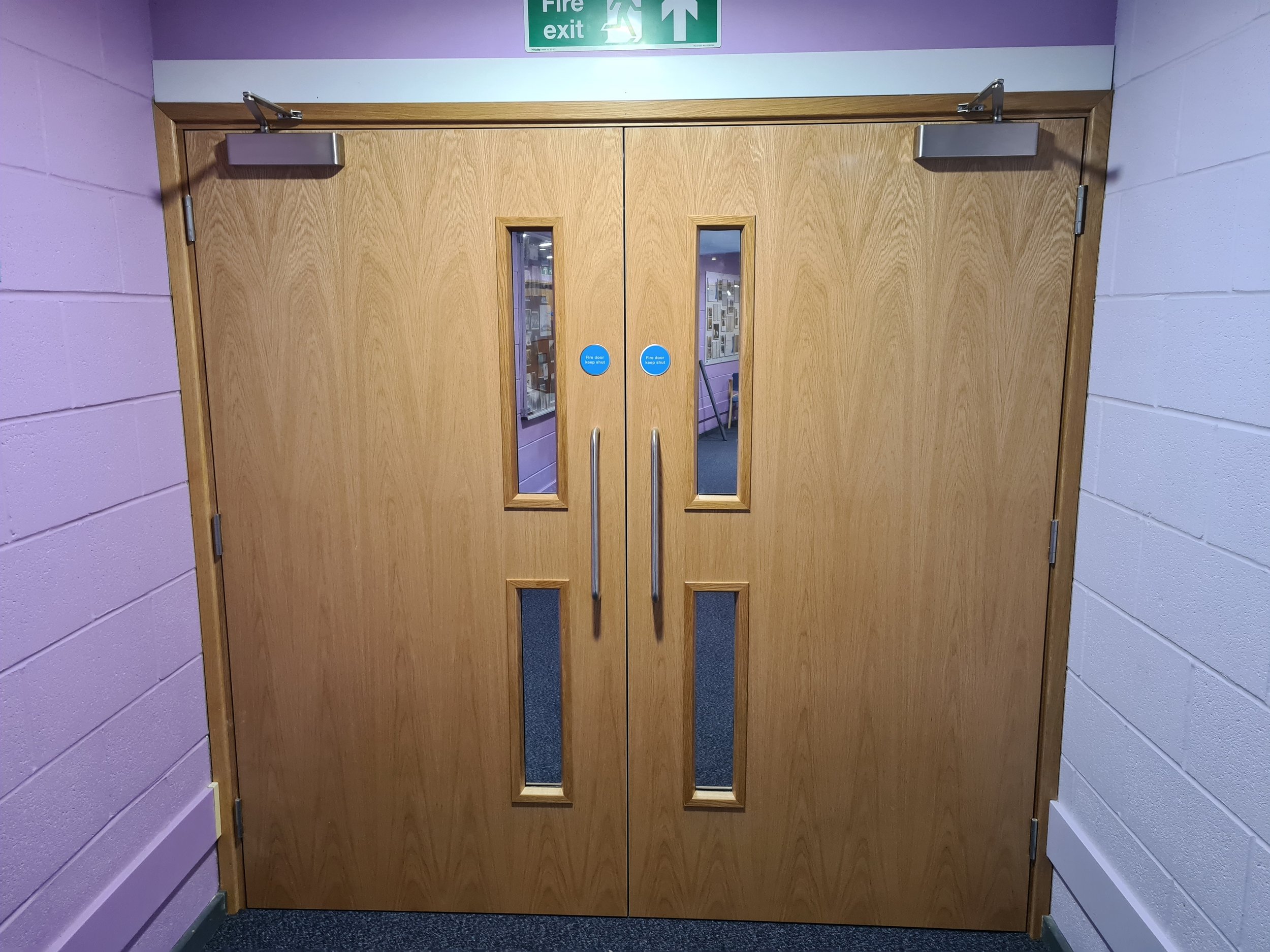
If you manage a commercial property, a block of flats, a school, or any other non-domestic building, you already know fire doors are a legal requirement. But knowing you have fire doors fitted and knowing those fire doors are compliant, maintained, and properly documented are two very different things.
This article explains what fire door compliance actually involves, what the law requires of you, and how a certified contractor can help you meet those obligations — with a paper trail to prove it.
Why Fire Doors Fail Inspections More Often Than You Might Expect
Fire doors are not a fit-and-forget installation. A fire door that was correctly installed five years ago may no longer perform as required. Components wear out, gaps open up, and doors that have been painted over, propped open, or had hardware replaced without like-for-like substitutions can all fail to perform in a fire.
The most common deficiencies found during fire door inspections include:
Intumescent seals that are damaged, missing, or have been painted over
Door gaps that exceed the maximum permitted — typically 3mm on side and top edges, 8mm at the bottom
Closers that are not functioning correctly or have been removed entirely
Hinges that are loose, missing, or have been replaced with non-fire-rated equivalents
Glazing that has been replaced without maintaining the fire resistance of the assembly
No visible certification label — making it impossible to verify what the door is rated for
Unsealed gaps behind the frame where firestopping has never been installed or has deteriorated
Any one of these issues can render a fire door non-compliant. In a real fire, a non-compliant door provides far less protection than the rated performance suggests — and in some cases, none at all.
What the Law Requires
The legal framework around fire doors in England has become significantly more demanding in recent years. Building owners, landlords, and responsible persons need to understand the following:
Regulatory Reform (Fire Safety) Order 2005
The RRO places a duty on the responsible person — typically the building owner, employer, or managing agent — to ensure that fire doors are maintained in efficient working order at all times. This includes the door leaf, frame, hardware, seals, and any associated glazing. Failure to comply can result in enforcement action and unlimited fines.
Building Safety Act 2022
For higher-risk residential buildings — broadly those above 18 metres or seven storeys — the Building Safety Act introduces far more stringent requirements. Regular fire door checks must be carried out: at least every 12 months for flat entrance doors, and every three months for communal fire doors. Crucially, all checks and any remedial works must be recorded and retained as part of the building's golden thread of information.
Building Regulations Approved Document B
For new builds and refurbishment works, Approved Document B sets out the standards fire doors must meet, including the required fire resistance rating for each location and the specification of all door components.
What a Professional Fire Door Inspection Involves
A competent fire door inspection is far more thorough than a visual check. At Lockmasters, our qualified inspectors carry out a component-by-component assessment of every fire door assembly, covering:
The door leaf — checking for damage, correct fit, and any alterations that may affect performance
Intumescent and smoke seals — condition, continuity, and correct specification
Hardware — closer function, hinge count and condition, lock or latch engagement
Gaps — measured on all four edges to verify they are within tolerance
Glazing — where present, checked for correct specification and intact seals
Frame condition — looking for damage, movement, and evidence of unsatisfactory fixings
Architrave and frame-to-substrate condition — checking that firestopping behind the frame is intact
Certification label — verified against the installed doorset where possible
Following inspection, you receive a clear written report identifying every deficiency, a prioritised schedule of remedial works, and expert guidance on maintaining compliance going forward.
The Difference BMTrada Q-Mark Certification Makes
When commissioning fire door inspections, maintenance, or installation, the certification held by your contractor matters.
Lockmasters hold BMTrada Q-Mark certification for both fire door installation and fire door maintenance — one of the most rigorous independent certification schemes available in the passive fire protection industry. This means:
Our operatives have been trained and assessed to carry out fire door work under a certified, audited scheme
Installations and repairs are carried out strictly in accordance with manufacturer-tested details
Every completed door receives Q-Mark certification labelling
You receive a full documentation pack — not just the work, but the evidence that it was done correctly
This level of documented, third-party-assured work is increasingly expected by building insurers, fire risk assessors, and for higher-risk buildings required under the Building Safety Act.
Fire Door Services Across Hampshire & Surrey
Lockmasters have been serving commercial, residential, educational, and public sector clients across Hampshire and Surrey for over 30 years. Our fire door services include:
Fire door inspections and compliance surveys
BMTrada Q-Mark certified fire door installation (FD30 and FD60 rated doorsets)
Fire door maintenance and remedial repairs using Q-Mark Accepted Repair Techniques
Full documentation packs suitable for fire safety files and golden thread records
We cover Farnham, Alton, Guildford, Fleet, Farnborough, Camberley, Basingstoke, Haslemere, Aldershot, Bordon and all surrounding areas.
Frequently asked questions
How often do fire doors need to be inspected in Hampshire?
The Regulatory Reform (Fire Safety) Order 2005 requires fire doors to be kept in efficient working order at all times, which most guidance interprets as a minimum of every six months for communal doors in residential buildings. For higher-risk residential buildings under the Building Safety Act 2022, communal fire doors must be checked at least every three months, and flat entrance doors at least every 12 months. High-traffic doors — such as those in schools, hospitals, or busy commercial premises — should be inspected more frequently.
What makes a fire door non-compliant?
Common reasons include damaged or missing intumescent seals, door gaps that exceed permitted tolerances, a closer that has been removed or is not functioning, non-fire-rated replacement hardware, glazing that has been changed without maintaining fire resistance, and no visible certification label. Any single deficiency can affect the door's rated performance.
Does a fire door inspection have to be carried out by a certified contractor?
The legislation requires inspections to be carried out by a competent person but does not specify a named certification. However, using a BMTrada Q-Mark certified operative or a member of the Fire Door Inspection Scheme (FDIS) gives you demonstrable, documented evidence of competence — which is increasingly expected by insurers, fire risk assessors, and building safety regulators.
What is the difference between FD30 and FD60 fire doors?
FD30 doors are tested to resist the spread of fire and smoke for a minimum of 30 minutes. FD60 doors provide a minimum of 60 minutes. The required rating for any given location is determined by your building's fire strategy and will be specified by a fire engineer or building control. Lockmasters install both ratings across a range of doorset types and configurations.
What documentation should I receive after fire door works?
As a minimum you should receive photographic evidence before, during and after works, product data sheets for all materials used, a record of the installation or maintenance activities carried out, and certification labelling on the completed doors. For buildings within scope of the Building Safety Act 2022, this documentation forms part of the required golden thread of building information and must be retained and kept up to date.
Do you carry out fire door surveys as well as installation and maintenance?
Yes. Lockmasters carry out both intrusive and non-intrusive fire door surveys, producing a written report with photographic evidence, a prioritised schedule of any remedial works required, and compliance reporting suitable for landlords, building owners, and managing agents.
Get a Fire Door Inspection Quote
If you are unsure whether your fire doors are compliant — or if you know remedial work is needed but have not yet acted — we would be happy to help. We offer site surveys across Hampshire and Surrey with no obligation, and every project comes with full documentation as standard.
Find out more about our fire door services or contact us to arrange a survey.